
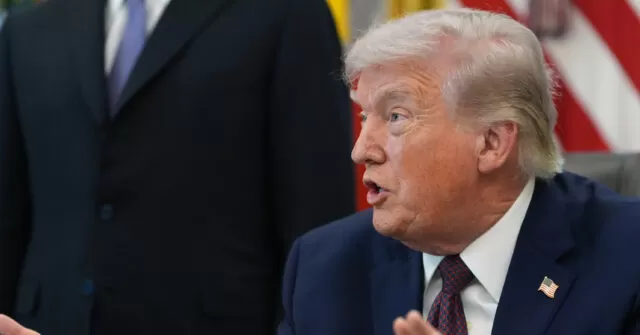
President Donald Trump has recently made a bold statement indicating that the United States may withdraw from the North Atlantic Treaty Organization (NATO). This comes after his call for direct aid in securing the Middle East from Iranian threats, which was seemingly ignored by many European nations. The British newspaper, Breitbart, has detailed this development, shedding light on Trump’s frustrations and highlighting the possibility of a US departure from NATO.
For decades, the US has been a key member of NATO, an intergovernmental military alliance between 30 North American and European countries. The alliance was formed in 1949 as a means of collective defense against the Soviet Union and has since played a crucial role in promoting security and stability in the region. However, Trump’s recent remarks have raised questions about the future of this alliance and the US’s role in it.
In an interview with Breitbart, President Trump expressed his disappointment with Europe’s lack of response to his call for support in the Middle East. He stated that many European countries are not fulfilling their financial obligations towards NATO and are not contributing enough to the alliance. He also pointed out that these same nations are not reciprocating the US’s efforts in the region, particularly in the fight against Iran’s aggression. This failure to reciprocate has led Trump to consider withdrawing the US from NATO, which he calls a “paper tiger.”
These comments have sparked a debate about the effectiveness and relevance of NATO in today’s world. While some argue that the alliance is still necessary for collective defense and global stability, others believe that it has outlived its purpose, and the US should focus on its own national interests. However, it is essential to understand the potential consequences of a US withdrawal from NATO.
Firstly, it would have a significant impact on the security of Europe. The US is the largest contributor to NATO’s budget and has been a key player in ensuring the alliance’s military capability. Its departure would leave a significant void, and European nations would have to increase their spending on defense to compensate for the loss. This could strain their already fragile economies and potentially weaken their military capabilities.
Moreover, a US withdrawal from NATO would also have geopolitical implications. It would send a message to Russia that the US is weakening its commitment to European security. This could embolden Moscow to take aggressive actions in the region, posing a threat to European countries. It could also have a ripple effect on other global alliances, as countries may start questioning the US’s reliability as an ally.
However, it is crucial to note that Trump’s remarks and the possibility of a US withdrawal from NATO should not be taken lightly. The President has been a vocal critic of the alliance since his election campaign and has repeatedly called on European nations to increase their military spending. Despite the US’s significant contributions to NATO, only a few countries have met the alliance’s goal of spending 2% of their GDP on defense. This has been a longstanding issue for the US, and Trump’s frustration is understandable.
On the other hand, European leaders have raised concerns about Trump’s approach to NATO and his lack of commitment to multilateralism. They argue that the US’s withdrawal from the alliance would not only undermine European security but also damage the transatlantic relationship. Some have also questioned the timing of Trump’s remarks, as tensions with Iran are at an all-time high, and a united front is crucial in dealing with the situation.
In conclusion, President Trump’s comments about the US reconsidering its membership in NATO have raised significant concerns about the future of the alliance. While some argue that it is time for the US to focus on its national interests, others believe that NATO is still a crucial platform for collective defense. As the debate continues, it is essential for all parties to find a solution that ensures the security and stability of both Europe and the US. It is also crucial for European nations to fulfill their financial obligations to NATO and work towards strengthening the alliance, rather than relying solely on the US. Only through cooperation and unity can we effectively address the challenges facing the world today.