
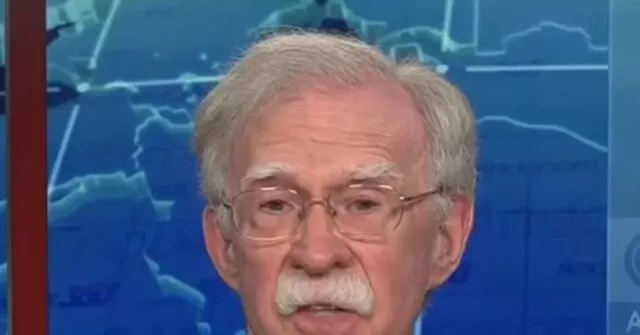
On Monday, former national security adviser John Bolton made a startling revelation on CNN’s “News Central.” He claimed that President Donald Trump had “put the gun on the table” in an attempt to overthrow Venezuelan President Nicolás Maduro. This statement has caused quite a stir in the political world, with many questioning the actions of the Trump administration towards the South American country.
Bolton, who served as Trump’s national security adviser from April 2018 to September 2019, spoke to CNN’s Wolf Blitzer about the ongoing crisis in Venezuela. He expressed his belief that the United States should have taken a more aggressive approach towards Maduro’s regime, stating that Trump had “put the gun on the table” but ultimately did not follow through with it.
The former national security adviser’s comments come at a time when tensions between the U.S. and Venezuela are at an all-time high. The two countries have been at odds since January 2019, when Trump recognized Juan Guaidó as the legitimate president of Venezuela, instead of Maduro. The U.S. has imposed numerous sanctions on the South American country, in an attempt to force Maduro out of power.
Bolton’s statement has caused a divide among politicians and experts, with some questioning the validity of his claims. However, there is no denying that the Trump administration has been vocal about their desire to see Maduro removed from power. In fact, just last year, Trump stated that he would consider a military intervention in Venezuela, if necessary.
But what does “putting the gun on the table” actually mean? According to Bolton, it means using the threat of military force to pressure Maduro into stepping down. This tactic has been used by the U.S. in the past, most notably in the 1989 invasion of Panama to remove dictator Manuel Noriega from power.
Bolton’s statement has also shed light on the inner workings of the Trump administration’s foreign policy towards Venezuela. It has been reported that there were disagreements within the administration on how to handle the crisis in the country. Bolton’s departure from the White House in September 2019 was seen as a sign of these differences.
The former national security adviser’s comments have also reignited the debate on whether the U.S. should intervene in the affairs of other countries. Many have criticized the U.S. for its involvement in the political unrest in Venezuela, arguing that it is not the place of a foreign power to interfere in the internal affairs of a sovereign nation.
Despite the controversy surrounding Bolton’s statement, it has once again brought attention to the dire situation in Venezuela. The country has been plagued by economic turmoil, corruption, and human rights violations under Maduro’s regime. The people of Venezuela have suffered greatly, with many facing food and medicine shortages, as well as rampant inflation.
It is clear that something needs to be done to help the people of Venezuela. However, the question remains, what is the best course of action? Bolton’s statement has sparked a debate on the effectiveness of using military force as a means to bring about change in a country. Some argue that it would only lead to further chaos and instability, while others believe it may be the only way to remove a corrupt leader from power.
In the end, it is up to the Trump administration to decide how to handle the crisis in Venezuela. However, one thing is certain, the people of Venezuela deserve a better future. It is our hope that a peaceful resolution can be reached, and the country can begin to heal from the damage caused by Maduro’s regime.
In conclusion, John Bolton’s revelation on CNN’s “News Central” has once again brought attention to the ongoing crisis in Venezuela. While his statement may have caused controversy, it has also sparked an important debate on the role of the U.S. in international affairs. It is our hope that a peaceful solution can be reached, and the people of Venezuela can finally see a brighter future ahead.