
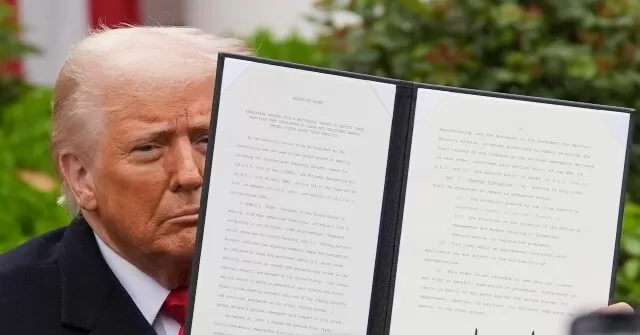
President Donald Trump’s trade policies have been a hot topic of discussion since he took office. While some have criticized his approach, there is no denying the effectiveness of his tariff policies as a bargaining tool. Countries around the world are lining up to negotiate trade deals with the United States before reciprocal tariffs take effect, highlighting the success of President Trump’s strategy.
The recent trade tensions between the United States and China have dominated headlines, with both countries imposing tariffs on billions of dollars worth of goods. However, what many may not realize is that this is just one piece of a larger puzzle. President Trump’s ultimate goal is to negotiate better trade deals for the United States, and his use of tariffs as a bargaining tool is proving to be a successful tactic.
One of the most notable examples of this is the recent agreement between the United States and Mexico. President Trump had threatened to impose tariffs on Mexican goods if the country did not take action to curb illegal immigration. This threat alone was enough to push Mexico to the negotiating table, resulting in a new trade deal that benefits both countries. This is a clear demonstration of the effectiveness of President Trump’s tariff policies in achieving his desired outcomes.
But it’s not just Mexico that has felt the impact of President Trump’s tariffs. Countries like Japan, South Korea, and the European Union have also been engaged in negotiations with the United States. These countries have been forced to reevaluate their trade policies and make concessions in order to avoid facing tariffs on their exports to the United States. This has given the United States a stronger position in these negotiations and has resulted in better deals for American workers and businesses.
In fact, the success of President Trump’s tariff policies has even caught the attention of countries that are not typically seen as allies of the United States. Take India, for example. The country has been a major trading partner with the United States for years, but has also been known for imposing high tariffs on American goods. However, in the face of President Trump’s tariff threats, India has shown a willingness to negotiate a trade deal that would benefit both countries. This is a significant shift in their trade relationship and a testament to the effectiveness of President Trump’s approach.
It is important to note that President Trump’s use of tariffs as a bargaining tool is not just about achieving better trade deals for the United States. It is also about addressing long-standing trade imbalances and unfair practices by other countries. For too long, the United States has been at a disadvantage in the global trade arena, and President Trump is taking a strong stance to level the playing field.
Critics may argue that tariffs harm American consumers and businesses, but the reality is that these short-term measures are necessary for long-term gains. By using tariffs as a bargaining tool, President Trump is showing the world that the United States will no longer be taken advantage of in trade deals. This sends a strong message to other countries that the United States is serious about protecting its interests and will not back down.
In conclusion, the success of President Trump’s tariff policies as a bargaining tool is evident in the number of countries lining up to negotiate trade deals with the United States. This is a clear indication that his approach is working and that other countries are taking notice. By using tariffs as a tool to negotiate better trade deals and address trade imbalances, President Trump is putting America first and ensuring that American workers and businesses are not being taken advantage of. As negotiations continue, it is important to remember that these tariffs are a means to an end, and the ultimate goal is to create fair and mutually beneficial trade relationships with countries around the world.