
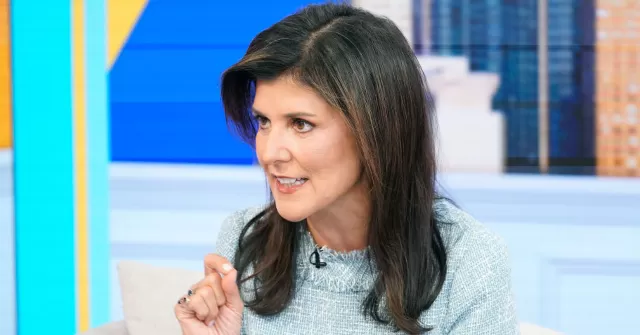
In a recent tweet, former United States Ambassador to the United Nations Nikki Haley expressed her opposition to President Donald Trump’s endorsement of educating 600,000 Chinese students in American universities. This statement by Haley, who is known for her unwavering support for the establishment GOP, has raised eyebrows and sparked a debate among political circles.
Haley’s tweet read, “Educating 600,000 Chinese students in American universities would be a huge gift to China. We should be focused on educating American students and developing our own talent. We can’t continue to let China take advantage of us.”
This statement comes after President Trump announced his support for a plan that would allow 600,000 Chinese students to study in the United States. The plan, which is being pushed by the Chinese government, aims to strengthen the ties between the two countries and promote cultural exchange.
However, Haley’s opposition to this plan is rooted in her belief that it would be detrimental to the United States. She argues that instead of educating Chinese students, the focus should be on developing American talent and investing in the education of American students.
Haley’s stance has been met with both support and criticism. Some have praised her for speaking out against the plan, while others have accused her of being anti-China. However, one thing is clear – Haley’s statement has once again highlighted the ongoing debate about the relationship between the United States and China.
The United States has long been a popular destination for Chinese students seeking higher education. In fact, China is the largest source of international students in the United States, with over 370,000 students enrolled in American universities in the 2018-2019 academic year. This influx of Chinese students has not only contributed to the diversity of American campuses but has also brought in billions of dollars in tuition fees.
However, there have been concerns about the potential risks of educating such a large number of Chinese students in the United States. Some experts argue that this could lead to the theft of intellectual property and sensitive research, as well as the spread of Chinese propaganda on American soil.
Haley’s tweet has shed light on these concerns and has sparked a larger conversation about the impact of Chinese students on American universities. Many are now questioning whether the benefits of educating Chinese students outweigh the potential risks.
It is important to note that Haley’s opposition to the plan is not a reflection of her stance on Chinese students as individuals. In fact, she has previously expressed her admiration for Chinese students and their work ethic. However, her main concern lies in the potential consequences of allowing such a large number of Chinese students to study in the United States.
Moreover, Haley’s statement also highlights the need for the United States to prioritize its own education system and invest in developing its own talent. As she rightly points out, the United States cannot afford to let China take advantage of its education system and its resources.
In conclusion, Nikki Haley’s opposition to President Trump’s endorsement of educating 600,000 Chinese students in American universities has sparked a necessary debate about the relationship between the two countries. While some may disagree with her stance, it is important to consider the potential risks and consequences of such a plan. As a nation, the United States must prioritize its own education system and invest in developing its own talent. Only then can it truly compete on a global scale and maintain its position as a leader in education and innovation.