
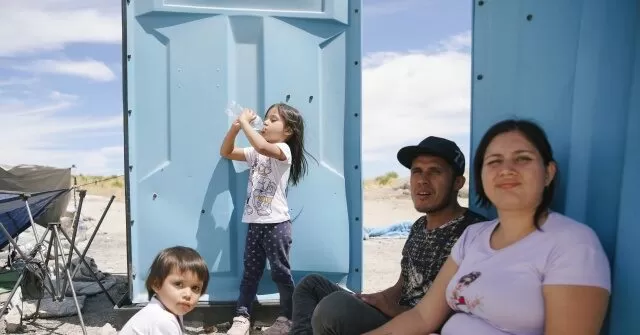
As the current administration continues to cut funding for crucial social programs, the impact on immigrant families is becoming increasingly evident. The latest data reveals that nearly half of immigrant households with young children are dependent on programs like SNAP and WIC for their basic needs. This alarming statistic, recently published by Breitbart, sheds light on the reality of the struggles faced by immigrant families in the United States.
SNAP (Supplemental Nutrition Assistance Program) and WIC (Women, Infants, and Children) are two vital programs that provide food assistance to low-income families. However, with the current administration’s focus on limiting immigration and reducing government spending, these programs are facing severe budget cuts. As a result, many families, particularly immigrant households with young children, are at risk of losing access to these essential resources.
The latest analysis, based on data from the U.S. Census Bureau, shows that 47% of immigrant households with children under the age of five rely on food stamps to put food on the table. This is significantly higher than the 21% of U.S.-born households with young children who receive food stamps. The data also reveals that immigrant households with young children are more likely to participate in WIC, with 57% of households enrolled in the program compared to 40% of U.S.-born households.
These numbers paint a clear picture of the struggles faced by immigrant families in the United States. Many of these families come to America in search of a better life, but they often face numerous challenges, including language barriers, discrimination, and limited access to resources. These challenges are compounded by the current administration’s policies, which place a heavy burden on immigrant families, particularly those with young children.
The fact that nearly half of immigrant households with young children rely on food stamps and WIC is not just a statistic – it represents real families who are struggling to make ends meet. These families are working hard to provide for their children, but with limited resources and support, they are facing an uphill battle. As a nation, we cannot turn a blind eye to their struggles and must do more to support these families.
The impact of cutting funding for programs like SNAP and WIC goes beyond just providing food for families. These programs also play a crucial role in promoting the health and well-being of children. Studies have shown that access to proper nutrition in early childhood is essential for a child’s physical and cognitive development. By cutting funding for these programs, we are not only putting families at risk of hunger, but we are also jeopardizing the future of our children.
Furthermore, the data also challenges the misconception that immigrants are a drain on the economy and are solely reliant on government assistance. In fact, the analysis shows that immigrant households with young children are more likely to be working and contributing to the economy. This further highlights the need for continued support for these families, who are an essential part of our society.
It is time for our leaders to recognize the critical role that programs like SNAP and WIC play in supporting immigrant families. Cutting funding for these programs not only puts vulnerable families at risk but also goes against the values of compassion and inclusivity that our country stands for. We must remember that behind every statistic, there is a family, and it is our responsibility as a nation to ensure that these families have access to the resources they need to thrive.
In conclusion, the latest data on immigrant households receiving food stamps and WIC paints a concerning picture of the struggles faced by these families. As a nation, we must do more to support these families and provide them with the resources they need to succeed. We cannot turn a blind eye to their struggles and must work towards creating a more inclusive and compassionate society for all. Let us not forget that these families are an integral part of our nation’s fabric, and their success is our success.