
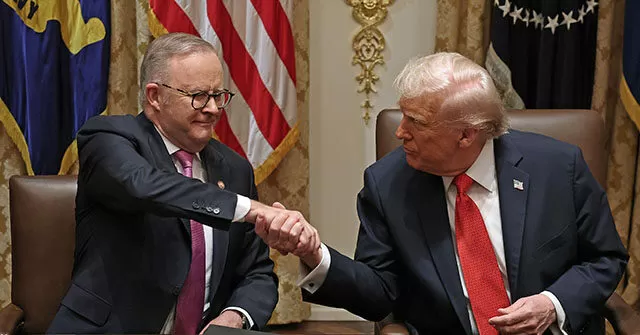
Washington – In a significant move towards strengthening economic ties, President Donald Trump and Australian Prime Minister Anthony Albanese signed a rare earths and critical minerals deal on Monday at the White House. This comes as Trump continues to engage in bilateral meetings with world leaders, further solidifying America’s position in the global market.
The deal, which was signed in the presence of top officials from both countries, aims to boost US access to rare earth elements and critical minerals, which are vital for the production of various high-tech products. The agreement will facilitate the development of a secure supply chain for these minerals and reduce America’s dependence on foreign sources, thus bolstering the country’s national security.
Addressing the media after the signing, President Trump emphasized the importance of this deal for America’s economic growth and security. He said, “Today’s agreement marks an important step towards increasing our access to rare earth elements and critical minerals, which are essential for our economy and national security. We are proud to have such a strong ally like Australia in this endeavour.”
Rare earth elements and critical minerals are used in the production of a wide range of products, including smartphones, laptops, and electric vehicles. However, the global supply of these minerals is largely dominated by China, which has caused much concern for countries like the United States. This deal with Australia will provide an alternative source for these minerals and reduce America’s reliance on China.
Australian Prime Minister Anthony Albanese also hailed the deal as a major milestone in the strong relationship between the two countries. He remarked, “This agreement demonstrates the close partnership between Australia and the United States and our commitment to strengthening our economic cooperation. With this deal, we are not only enhancing our economic ties, but also promoting a stable and secure global supply chain for critical minerals.”
Apart from boosting the supply of rare earths and critical minerals, the deal also aims to enhance cooperation in the research and development of new technologies. This will lead to the creation of new jobs and opportunities in both countries, boosting their respective economies.
This is not the first time that President Trump has focused on securing America’s access to rare earth elements and critical minerals. In 2019, he issued an executive order to reduce America’s reliance on foreign sources and promote domestic production of these minerals. This new deal with Australia is an extension of that effort, further advancing America’s economic and national security goals.
With the signing of this deal, America and Australia have once again demonstrated their strong and enduring alliance. It is a testament to the shared values and interests of the two countries, as well as their commitment to promoting global economic stability and security. This agreement will not only benefit the two nations, but also contribute towards a more prosperous and secure world.
The deal has been widely praised by business leaders and experts, who believe it will have a positive impact on America’s economy. They see this deal as a significant step towards reducing the country’s dependence on China and diversifying its supply chain.
In the midst of a global pandemic and economic uncertainty, this deal between America and Australia brings a ray of hope and reinforces confidence in the strength of their partnership. It showcases the ability of two nations to work together towards a common goal, even in the face of challenges.
In conclusion, the rare earths and critical minerals deal signed by President Trump and Prime Minister Albanese is a significant achievement for both countries. It not only strengthens their economic ties, but also promotes stability and security in the global market. This agreement reaffirms the strong alliance between the two nations and sets the stage for future collaborations, benefiting both economies and the world at large.