
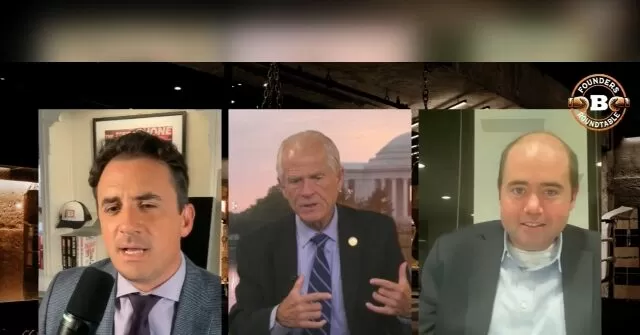
In a recent special Founders Roundtable on Breitbart Fight Club, Peter Navarro, senior counselor to President Donald Trump for trade and manufacturing, made a bold prediction about India’s future alliances. According to Navarro, the Indian government will soon have to make a choice between its alliance with the United States and its business partnerships with Russia and China.
Navarro’s statement comes at a time when the world is closely watching the shifting dynamics of global politics and trade. With the rise of the BRICS nations (Brazil, Russia, India, China, and South Africa), India has found itself in a unique position of balancing its relationships with both the US and its BRICS counterparts. However, Navarro believes that this balancing act cannot continue for long and India will have to choose a side.
During the roundtable, Navarro highlighted the growing economic and military power of China and Russia, and the potential threat it poses to the United States. He also pointed out India’s close ties with these two nations, particularly in terms of trade and business. According to Navarro, India’s continued partnership with China and Russia could potentially harm its relationship with the US, which is a key ally and trading partner.
Navarro’s words have sparked a debate among experts and policymakers in India. While some believe that India should prioritize its alliance with the US, others argue that maintaining good relations with China and Russia is crucial for the country’s economic growth. However, Navarro’s message is clear – India cannot continue to have it both ways.
The US has been a long-standing ally of India, and the two countries have shared a strong bond based on mutual interests and values. In recent years, this relationship has only grown stronger, with the US supporting India’s bid for a permanent seat in the United Nations Security Council and India becoming a major defense partner of the US. The US has also been a key contributor to India’s economic growth, with trade between the two countries reaching over $142 billion in 2018.
On the other hand, India’s relationship with China and Russia has been marked by both cooperation and competition. While India and China have been working together on various global platforms, such as the BRICS and the Shanghai Cooperation Organization, they have also been involved in territorial disputes and have competing interests in the region. Similarly, India and Russia have a long history of strategic and defense cooperation, but their economic ties have been relatively weak.
Navarro’s prediction has raised concerns about the impact of India’s potential shift towards the US on its relationship with China and Russia. However, it is important to note that India’s foreign policy has always been guided by its national interests, and the country has a history of maintaining good relations with multiple nations. India’s Prime Minister Narendra Modi has also emphasized the importance of a multi-polar world and has actively pursued partnerships with various countries, including the US, China, and Russia.
In light of Navarro’s statement, it is crucial for India to carefully consider its options and make a decision that best serves its national interests. While maintaining a strong alliance with the US is important, India cannot afford to ignore its relationships with China and Russia, which are also crucial for its economic growth and security. It is also important for the US to understand India’s position and work towards strengthening the relationship rather than pressuring India to choose sides.
In conclusion, Peter Navarro’s prediction has sparked a much-needed conversation about India’s alliances and its role in the changing global landscape. India must carefully weigh its options and make a decision that will benefit its people and its position in the world. As a country with a rich history and diverse culture, India has the potential to play a significant role in shaping the future of global politics and trade. It is up to the Indian government to make the right choice and continue to build strong partnerships with all nations, including the US, China, and Russia.